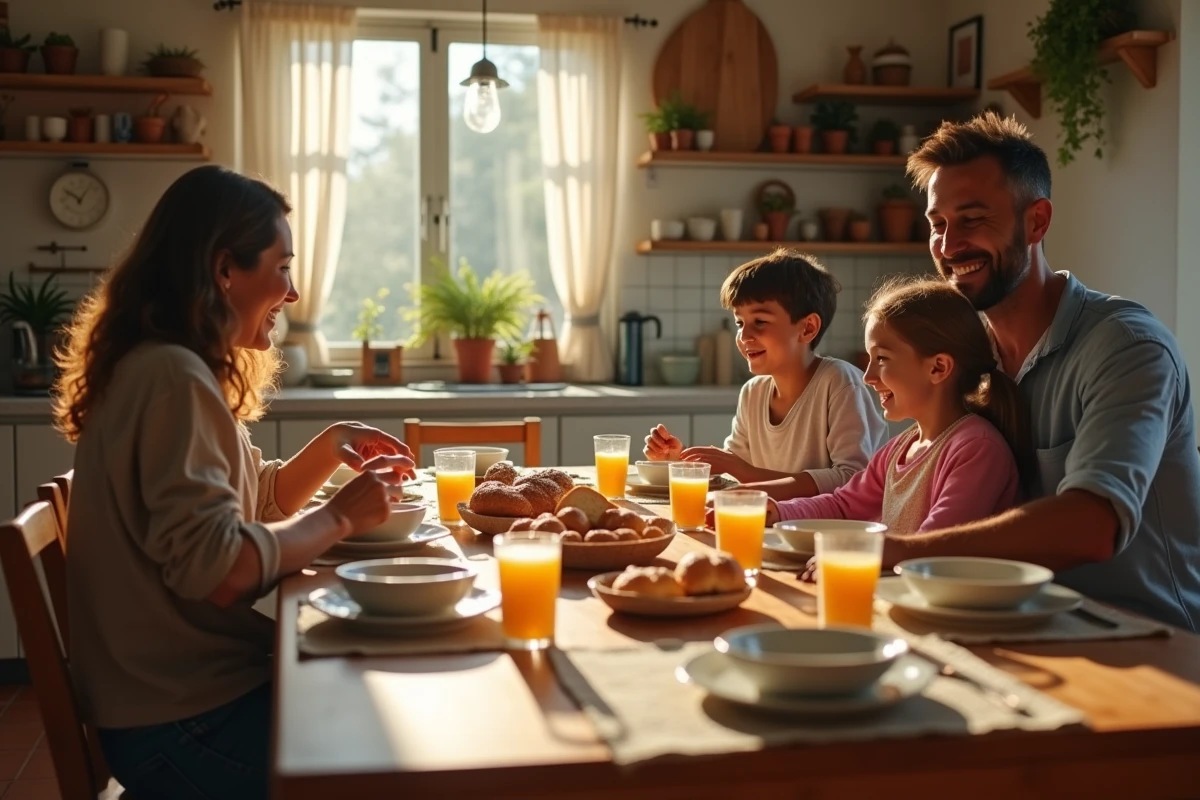
A fulfilling family life relies on concrete, reproducible, and adjustable mechanisms. The term refers to a family functioning where each member finds a space for expression, rest, and contribution, without the balance resting on a single person. General advice on family life often targets a unique model: two biological parents, children of the same age, symmetrical schedules. The reality of French households is more fragmented, and routines must adapt accordingly.
Collective ritual pause: an underutilized lever in France
The OECD survey “Family Well-being Index 2026” reveals that Scandinavian families more systematically integrate daily collective ritual pauses. This practice, which involves suspending all individual activities for a short shared moment, remains little adopted in French households.
The principle is simple: a fixed time slot, identical each day, where all members present at home gather without screens or ongoing tasks. The duration matters less than the regularity. For families where children have very different ages or staggered school schedules, this appointment can align with the only guaranteed moment of co-presence, often the evening meal or the return from school of the youngest.
The effect documented by the OECD is increased resilience in the face of family surprises. When a shared ritual exists, occasional tensions (homework, disputes, fatigue) dissipate more quickly because the group has a predictable rallying point. To discover family life on Maman du Net, additional resources allow for exploring these dynamics of positive parenting.

Family routines in multigenerational blended families
Advice on family rituals assumes that all household members share the same references, history, and relationship to authority. In a multigenerational blended family, a cohabiting grandparent, children from different unions, and a recent stepparent do not share the same codes or proximity needs.
Building rituals without forcing fusion
The most common trap is trying to replicate a classic nuclear family model. Imposing an identical bedtime ritual on a teenager who lives in the home every other week and a four-year-old who is always present creates resistance, not cohesion.
The operational logic is the opposite: start from what each subgroup already accepts, then create gradual intersections.
- Identify existing micro-routines by subgroup (the grandparent who reads the newspaper at a fixed time, the two younger siblings who play together after snack time) and make them visible to the rest of the household without imposing them.
- Create a single weekly collective ritual, not daily, so that participation remains a choice felt as enjoyable and not an additional obligation.
- Allow each reference adult to manage the care and bedtime of their own children during the initial years of recomposition, rather than demanding immediate shared authority.
A ritual accepted by all is better than five rituals endured by half the household. The daily life of a blended family improves when everyone can name what suits them, including the need for solitude.
The role of cohabiting grandparents
A grandparent living under the same roof alters the dynamics of the parental couple and stress management. Their presence can relieve logistical burdens (picking up children, preparing a meal), but it complicates educational decision-making.
Clarity of roles matters more than goodwill. Defining early who supervises homework, who sets screen limits, and who manages conflicts between children prevents repeated disagreements. This distribution is discussed at regular intervals, as needs evolve with the children’s ages and the grandparent’s health.
Shared parental leave and couple balance in daily life
Law No. 2025-478 of July 15, 2025, amending the Labor Code encourages a more equitable distribution of child-related tasks by facilitating the sharing of parental leave. This regulatory framework changes the game for couples where one parent absorbed the majority of domestic burdens.
The issue for family life is not just administrative. When both parents concretely experience daily life with the children over significant periods, mutual understanding of mental load increases. Discussions about organization cease to be theoretical.
For blended families, this evolution also allows the stepparent to get involved in daily care during a leave period, which accelerates the building of a bond with stepchildren without that bond being forced solely by cohabitation.

Sleep and parenting: reducing exhaustion with concrete tools
The French Pediatric Association conducted a qualitative study among 500 mothers between 2025 and 2026. The results published in March 2026 show a significant decrease in maternal exhaustion among families using connected sleep trackers for their young children.
The interest in the tracker is not the technology itself, but the objectification of data. When a parent can show the other (or the doctor) a precise record of nighttime awakenings, the discussion about sharing nights becomes factual. The stress related to the feeling of not being believed or understood decreases.
In a multigenerational household, the tracker also helps explain to the cohabiting grandparent why the infant needs calm at certain hours, without the request being perceived as a personal reproach. The tool serves as a neutral mediator in daily management.
A fulfilling family life does not rely on a unique model applicable to all households. Blended, multigenerational, or single-parent families need routines adapted to their actual configuration. The legislative framework is evolving, tracking tools are improving, but the foundation remains the same: clarified roles, chosen rituals, and communication that starts from the concrete, not the ideal.